
Building a real estate SEO cluster from scratch is one of the most profitable editorial projects you can take on — and one of the most demanding. If you sell property in a competitive market like Miami, Los Angeles, or New York, you already know what you’re up against: Zillow, Realtor.com, and Redfin dominate the top 10 for virtually every transactional search. Going head-to-head with them on broad keywords is a fast way to waste time and budget.
The real path forward is building a solid real estate SEO cluster through content. Not just any content — a strategically planned real estate SEO cluster organized by funnel stage, optimized to avoid cannibalization, and produced at a pace no single person can sustain writing manually.
In this complete guide, I’ll show you exactly how Klusto solves that problem, step by step, using a fictional case study: Costa Plus Realty, a boutique agency starting its blog from zero.
Note: The case study is fictional (not a real client), but the workflows, conceptual screenshots, and numbers are representative of what you’d see in a real Klusto project.

The Problem Before Klusto
Imagine Costa Plus Realty has a WordPress site with 5 pages: home, sales services, vacation rental services, team, and contact. The typical setup. They want to launch a blog that generates organic leads. The question is: what do you write?
Without a system, your options look like this:
| Manual Approach | What It Costs You |
|---|---|
| Keyword brainstorm in a spreadsheet | 4–8 hours |
| Deciding what to post first and why | Arbitrary decisions with no data |
| Writing each post from scratch | 4–6 hours per post |
| Checking that posts don’t cannibalize each other | Nearly impossible to do manually |
| On-page SEO optimization (Rank Math) | 30–45 extra minutes per post |
| Total for 9 posts | 80–100 hours |
Klusto cuts that workload down to roughly 15–20 total hours, with consistent SEO quality and zero cannibalization between posts. Here’s how to build a real estate SEO cluster from start to finish.
Step 1 · Automatic Site Analysis (the Foundation of Your Real Estate SEO Cluster)
The first thing Klusto does when it connects to a WordPress site is read it. It doesn’t ask you what niche you’re in or which keywords you want to target — it figures that out on its own. Without this step, any real estate SEO cluster you plan will be based on guesswork.
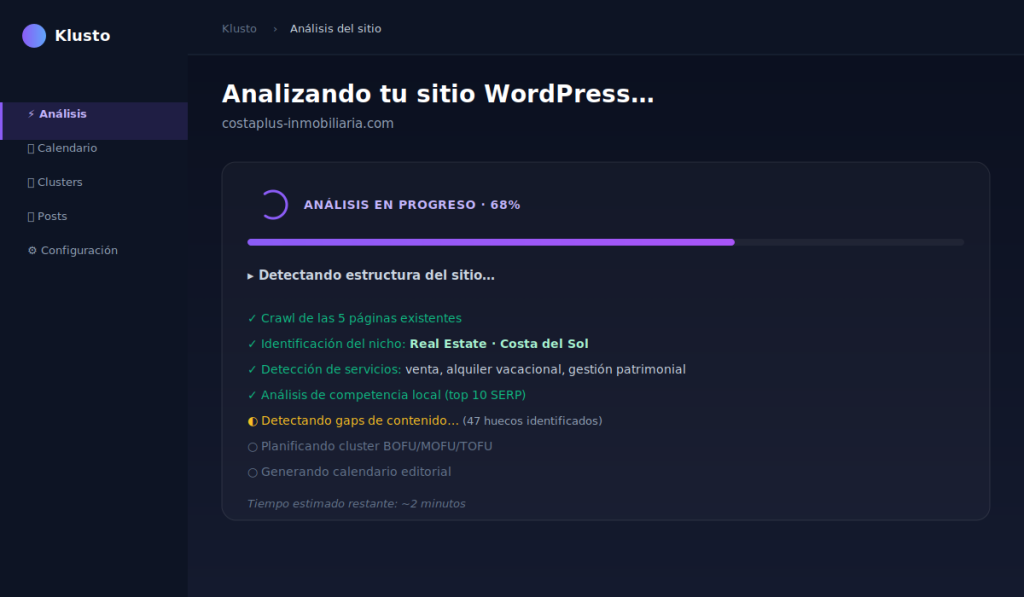
For Costa Plus Realty, Klusto:
- Crawls all 5 existing pages (~30 seconds).
- Identifies the niche: Real Estate · Coastal Market.
- Detects the 3 core services: sales, vacation rentals, and property management.
- Analyzes local competitors (top 10 SERPs for core keywords).
- Identifies 47 content gaps: topics competitors cover that the site doesn’t.
This matters because it determines which posts to write first. You don’t want a post on “minimalist decor for small apartments” (scattered TOFU) when you’re missing “mortgage for foreign buyers in the US” (MOFU with high commercial intent). Without prior analysis, any real estate SEO cluster ends up as an arbitrary list of topics rather than a coherent editorial strategy.
Step 2 · Planning the Real Estate SEO Cluster by Funnel Stage
Once the site is analyzed, Klusto proposes a thematic cluster organized by funnel stage. For Costa Plus Realty, the initial real estate SEO cluster looks like this:
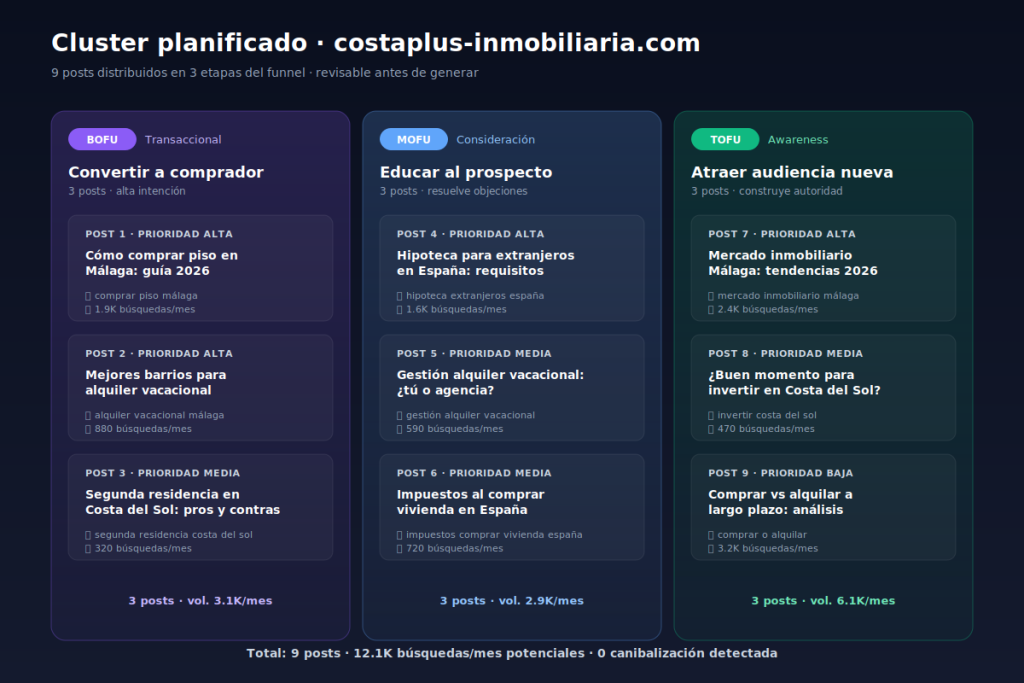
Three columns, three funnel stages, nine posts. Each post includes:
- A primary focus keyword with real search volume (data from Instituto Nacional de Estadística and SEO tools).
- A priority level (high, medium, low) based on commercial intent × volume × difficulty.
- A funnel stage that determines the content angle.
Here’s what each stage means.
BOFU (Bottom of the Funnel · Transactional)
Posts with high purchase intent. A user searching “how to buy a home in [city]” is much closer to contacting an agent than someone searching “housing market trends.” These posts:
- Have lower search volume but higher conversion rates.
- Target keywords with commercial modifiers (how to buy, best neighborhoods, comparison).
- Return leads fastest once they rank.
For Costa Plus Realty, Klusto prioritized 3 BOFU posts with a combined search volume of 3,100 searches/month. These are the pillars of the real estate SEO cluster that generate leads most quickly.
MOFU (Middle of the Funnel · Consideration)
Posts that educate prospects who are already considering a purchase. Someone searching “mortgage for foreign buyers” has probably already decided to buy, but they still need to resolve specific objections. These posts:
- Build trust with the reader.
- Address specific objections (legal, tax, operational).
- Are perfect for internal linking toward BOFU posts.
Costa Plus Realty will have 3 MOFU posts covering mortgages, property management, and tax considerations.
TOFU (Top of the Funnel · Awareness)
Posts that attract broad traffic and build topical authority. Someone searching “housing market trends 2026” isn’t necessarily ready to buy, but they’re engaged with the category. These posts:
- Have the highest search volume.
- Generate traffic that can be funneled to MOFU/BOFU posts via internal linking.
- Position your brand as a go-to industry resource.
For Costa Plus Realty, 3 TOFU posts target a combined 6,100 searches/month in potential traffic.
Cluster total: 9 posts, 12,100 searches/month in potential traffic, 0 cannibalization detected.
Step 3 · Anti-Cannibalization Across 3 Layers
Let’s talk about that last line: “0 cannibalization detected.” That’s not a coincidence. It’s what separates Klusto from every other AI content generator for WordPress — and what makes a scalable real estate SEO cluster actually viable.
Keyword cannibalization happens when two posts on the same site compete for the same search terms. Google gets confused, splits ranking signals between the two, and in the end neither ranks well. It’s a classic problem when you’re generating lots of posts without a strategy.
Klusto validates every new post against 3 layers:
- Layer 1 · Client service pages: the post must not cannibalize existing commercial pages (services, products, landing pages).
- Layer 2 · Previous cluster posts: the post must not overlap thematically with other posts already generated or planned.
- Layer 3 · Full WordPress content: cross-checked against the entire site (pages, posts, custom post types).
Here’s a real example of what happens when 2 cluster posts overlap:
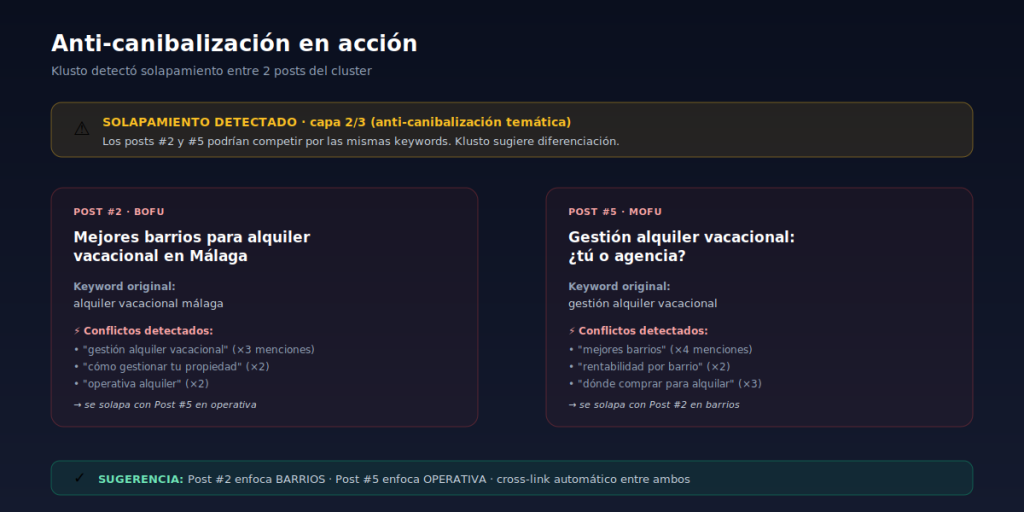
In this example, Post #2 (“Best neighborhoods for vacation rentals”) and Post #5 (“Vacation rental management: DIY or agency?”) were thematically overlapping. Klusto:
- Detected the overlap before generating either post.
- Suggested focusing Post #2 on neighborhoods (geographic angle) and Post #5 on operations (management angle).
- Scheduled automatic cross-links between them so they complement rather than compete with each other.
No other AI tool does this because it requires prior semantic analysis. Most tools generate first and break things later.
Step 4 · Generating the First Post in the Real Estate SEO Cluster
With the cluster approved and anti-cannibalization validated, Klusto is ready to generate. It selects Post #1 (“How to Buy a Home in [City]: Step-by-Step Guide 2026”) and gets to work.
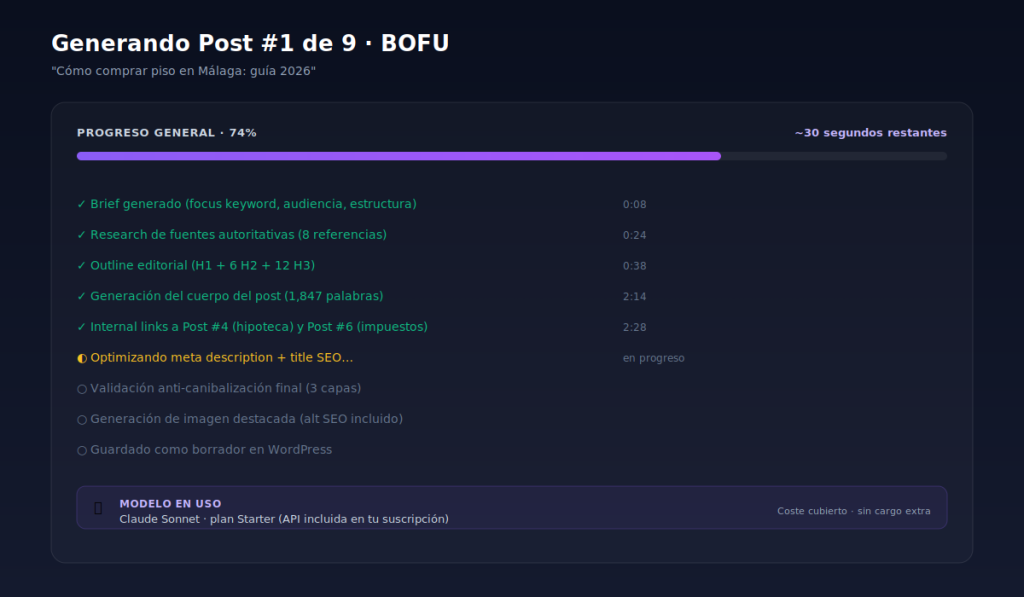
The generation workflow covers 8 automatic steps:
- Editorial brief: post structure (audience, angle, tentative headings).
- Source research: Klusto finds 6–8 authoritative references (Wikipedia, .gov/.edu sites, industry outlets) to cite within the post.
- Outline: H1 + 6 H2 + 12 H3 (typical structure for a 1,500–2,000-word BOFU post).
- Post body: 1,847 words in this case. Klusto generates paragraphs with the focus keyword distributed naturally at optimal SEO density.
- Internal links: Klusto cross-references the other planned posts and adds contextual links. In this post: links to Post #4 (mortgage) and Post #6 (taxes).
- SEO meta: title tag with exact keyword match, optimized meta description.
- Final anti-cannibalization check: re-validated against all 3 layers.
- Featured image: with an SEO
altattribute that includes the focus keyword.
Total generation time: ~3 minutes.
On Demo and Starter plans, the Claude API (Sonnet model) is included in your subscription — no extra charge for generation. On Pro+ plans, you bring your own Anthropic API key (learn how to get one here).
Step 5 · Your Real Estate SEO Cluster, Ready for Rank Math Review
Klusto saves the post as a draft in WordPress. This is where your human judgment comes in: review the result before publishing.
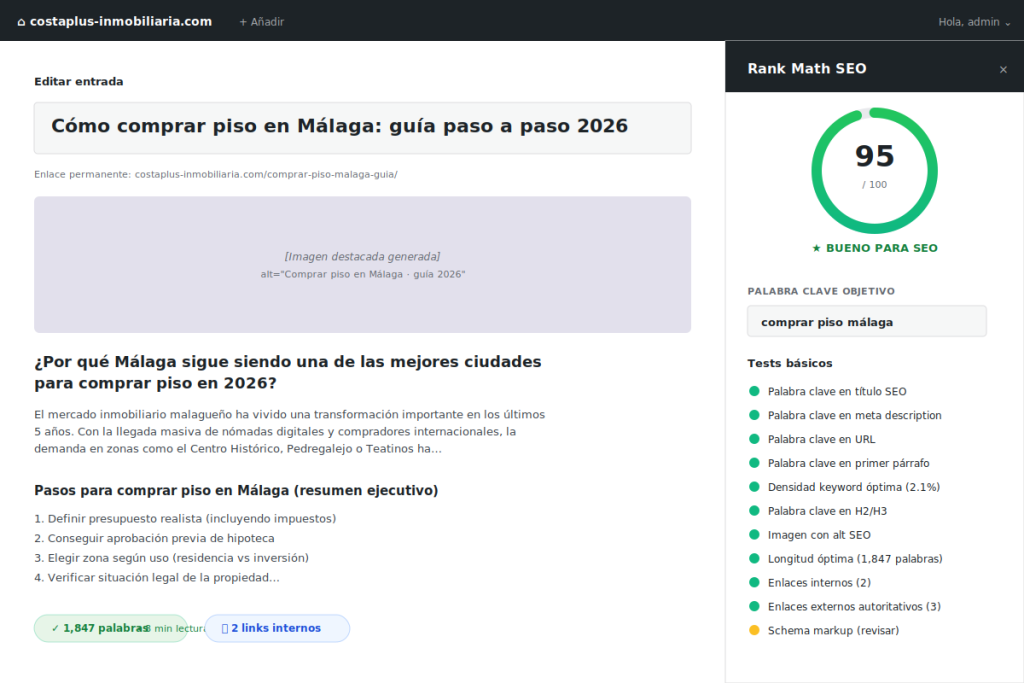
What you see when you open the draft:
- Title and slug already optimized with the exact focus keyword.
- Featured image generated with an SEO alt attribute.
- Content structured in hierarchical H2/H3 headings.
- Internal links active and pointing to the cluster posts.
- Rank Math panel showing 95/100 — without you touching a thing.
Checks that pass automatically:
- ✅ Focus keyword in SEO title, meta description, URL, and first paragraph
- ✅ Optimal keyword density (2.1%, within Rank Math’s 0.5–2.5% range)
- ✅ Focus keyword in H2 and H3 headings
- ✅ Image with SEO alt text
- ✅ Optimal length (1,847 words)
- ✅ Authoritative internal and external links
- ⚠️ Schema markup (review manually if you want specific rich snippets)
Your role as a human editor:
- Read the post (5–10 minutes) and adjust the voice if you want it to sound more corporate or more conversational.
- Validate specific data points: current market prices, recent regulations, proper names. Klusto works from good sources, but hyperlocal or very recent data points are yours to verify.
- Replace the generated featured image with a real photo from your inventory if you have one (recommended).
- Publish or schedule.
Total review time: 10–15 minutes per post vs. 4–6 hours of manual writing from scratch.
Projected Results for Your Real Estate SEO Cluster at 3 Months
Before we wrap up, an important disclaimer: Klusto does not guarantee specific Google rankings. That depends on your domain authority, local competition, site speed, backlinks, and dozens of other factors. What Klusto guarantees is the editorial system: the infrastructure that makes ranking possible in the first place.
A realistic projection for a new site launching a real estate SEO cluster in a competitive niche:
| Month | Posts Published | What Typically Happens |
|---|---|---|
| Month 1 | 8–10 | Google begins indexing; first impressions appear in Search Console |
| Month 2 | 16–20 | Long-tail positions on page 2–3; first organic traffic arrives |
| Month 3 | 24–30 | Cluster consolidated; first top-10 positions for secondary keywords |
| Month 6 | 40–50 | Topical authority established; BOFU keywords begin ranking competitively |
The difference isn’t about “having better content” — it’s about having a sustainable system. Anyone who tries this manually burns out by month one.
Does a Real Estate SEO Cluster Work for Your Niche?
Klusto is designed for verticals with a clear thematic cluster and defined search demand. The real estate SEO cluster in this tutorial is just one of many possible applications. It also works extremely well for:
- ✅ Real estate (this example)
- ✅ Dental clinics, physical therapy, and healthcare (with local cluster strategy)
- ✅ Legal and tax advisory firms
- ✅ Niche e-commerce (wine, sports equipment, tools)
- ✅ Digital marketing, SEO, and agency sites
It requires more manual adjustment for:
- ⚠️ Ultra-technical niches (specialized medicine, specific engineering disciplines)
- ⚠️ Pure personal brands (where the author’s voice is the product)
It’s not the right fit for:
- ❌ Products with regulations that change week to week (speculative crypto, rapidly shifting tax codes)
- ❌ Sites with no minimal editorial structure (Klusto needs at least a few existing pages to analyze)
Next Step
If you sell in a niche like real estate, healthcare, finance, or professional services — and your blog is stagnant or hasn’t launched yet — try Klusto free for 7 days, no credit card required.
Want to see what a planned cluster would look like for your specific niche? Reach out at get@klusto.ai and we’ll put together a personalized demo.
Klusto is a WordPress plugin that automates SEO content planning and generation using artificial intelligence. A product of BMD Creatives, LLC.

Written by
Klusto Team
Klusto is the WordPress plugin that automates your SEO blog with AI: plans BOFU/MOFU/TOFU clusters, prevents 3-layer cannibalization, and publishes optimized articles without leaving wp-admin. No external SaaS. No migration.